
Leading with Clarity: The Role of SIS in Christian School Success

Strong leadership in Christian education isn’t just about having vision—it’s about having visibility. The ability to clearly see what’s happening across your school, from student engagement to enrollment trends, is essential for making decisions that align with your mission.
Today’s Student Information Systems (SIS) are more than digital filing cabinets. When used well, they provide the insight, structure, and accountability school leaders need to steward their people, programs, and purpose with excellence.
Whether your school is well-established or just starting out, the role your SIS plays in daily operations can either create clarity or confusion. The difference lies not in the size of your school, but in how you use the tools at your fingertips.
For many Christian school leaders, the SIS has become a background tool—something that handles attendance, prints report cards, and perhaps supports scheduling or admissions. In reality, a well-utilized SIS can serve as the backbone of healthy leadership. It helps leaders identify trends early, understand the needs of their community, and make decisions grounded in accurate information rather than assumptions.
This matters for schools of every size. Even in smaller or newly established Christian schools, knowing who is missing too many days of school, where students are struggling academically, and which families may need additional support is mission-critical. In fact, the more responsibilities a leadership team carries, the more valuable operational clarity becomes. Time and attention are limited resources. A well-designed SIS helps leaders focus both where they matter most.
One helpful way to think about school information is through three simple concepts: Data, Decisions, and Drive.

Everything begins with data. Is your school collecting accurate and consistent information? Are teachers and staff using common definitions for attendance, behavior, grading, and student records? Are responsibilities clearly defined for entering and maintaining information? If the data entering your system is inconsistent, every report and dashboard built from it becomes less reliable.
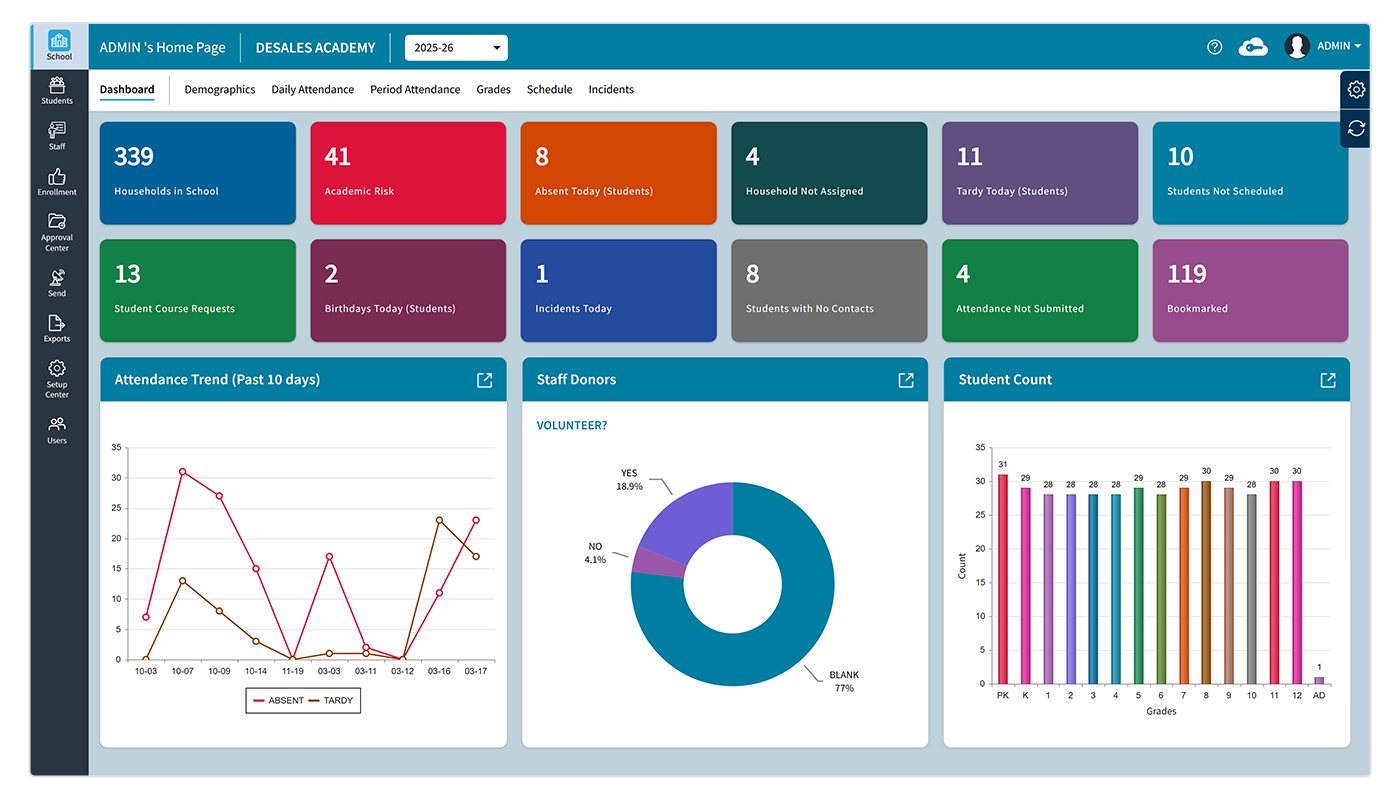
The second step is decisions. Information has little value if it simply sits in a database. A quality SIS provides dashboards, alerts, and reports that help school leaders make timely decisions. Whether identifying students who need additional academic support, monitoring enrollment trends, or evaluating attendance patterns, the system should transform information into actionable insight.

Finally, there is drive - the ability to measure progress over time. Schools rarely improve because of one major initiative. Instead, meaningful improvement happens through small, consistent decisions made over months and years. Comparing attendance from semester to semester, evaluating enrollment growth year over year, or measuring the impact of new academic initiatives allows leadership teams to see whether their efforts are producing lasting results.
Of course, effective leadership starts with collecting the right information. Every Christian school should maintain accurate demographic records, attendance, grades, behavior documentation, admissions information, and communication history with families. These are not simply administrative requirements—they tell the story of your school community.
Consider a student whose attendance has declined, whose grades are slipping, and who has recently experienced several disciplinary issues. Viewed separately, these appear to be unrelated events. Viewed together, they paint a picture of a student who may need additional support, encouragement, or intervention. A connected SIS helps leaders recognize these relationships before problems become crises.
One of the greatest advantages of modern school management systems is their ability to reduce administrative friction. Admissions forms can be completed online rather than on paper. Teachers can record attendance and classroom behavior in real time. Parent information updates can automatically flow throughout the system without requiring duplicate entry. When information is entered once and shared across appropriate areas, schools spend less time managing paperwork and more time serving students and families.
Stewardship is another essential consideration. Christian schools have been entrusted not only with educating students but also with caring for the personal information of every family they serve. A Student Information System should be treated as the school’s single source of truth, supported by clear user permissions, defined ownership of data, and regular reviews for accuracy. Good stewardship of information reflects the same integrity that schools seek to model in every other area of ministry.
Technology alone, however, does not create a data-informed school. Culture matters just as much as software. Schools that use data effectively establish shared expectations for data quality, provide ongoing professional development, and encourage leadership teams to model thoughtful, evidence-based decision-making. When faculty and staff understand that data exists to support students rather than evaluate people, the entire culture begins to shift.
Perhaps the best news for Christian schools is that improvement does not require a massive technology initiative. Meaningful change often begins with one dashboard, one report, or one recurring leadership conversation. A principal might begin by reviewing chronic absenteeism each month. An admissions director might monitor inquiry-to-enrollment conversion rates. A head of school might regularly examine enrollment trends alongside retention data. Small improvements in visibility often produce significant improvements in leadership.
As schools continue to grow, their systems should grow alongside them. Whether serving a startup academy with fifty students or a multi-campus Christian school with thousands, the right SIS provides a foundation that supports future expansion without sacrificing operational clarity. Features and capabilities become valuable because they are built upon accurate information and consistent processes.
Ultimately, this conversation is not really about software. It is about leadership.
Christian school leaders are called to make wise decisions that honor God, serve families, and help students flourish. Those decisions become stronger when they are supported by timely, accurate, and meaningful information. A Student Information System is simply one of the tools that makes faithful stewardship possible.

Leading with clarity means leading with confidence. It means replacing uncertainty with insight, reducing administrative burdens, strengthening communication, and creating systems that allow educators to spend more time investing in students and less time searching for information.
In the end, leadership is stewardship. And good stewardship begins with seeing clearly.
Share this Post: